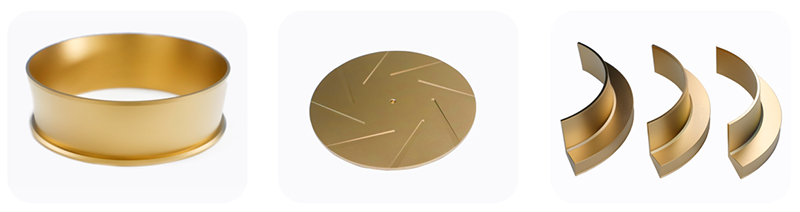
Semiconductor ceramic components
1. What materials are semiconductor ceramic parts made of?
(I) Alumina ceramics
Alumina ceramics are the "main force" in manufacturing ceramic parts. It has excellent mechanical properties, ultra-high melting point and hardness, corrosion resistance, good chemical stability, high resistivity, and good electrical insulation. It is often used to make polishing plates, vacuum suction cups, ceramic arms, etc.
(II) Aluminum nitride ceramics

Aluminum nitride ceramics have high thermal conductivity, a thermal expansion coefficient that matches silicon, and low dielectric constant and dielectric loss. With the advantages of high melting point, high hardness, good thermal conductivity, and strong insulation, it is mainly used in the production of heat dissipation substrates, ceramic nozzles, and electrostatic chucks.
(III) Yttria ceramics
Yttria ceramics have a high melting point, good chemical and photochemical stability, low phonon energy, high thermal conductivity, and good light transmittance. In the semiconductor industry, it is often used in conjunction with alumina ceramics, such as spraying yttria on alumina ceramics to make ceramic windows.
(IV) Silicon nitride ceramics
Silicon nitride ceramics have high melting points, super high hardness, stable chemical properties, a low thermal expansion coefficient, high thermal conductivity, and strong thermal shock resistance. Below 1200°C, it has excellent impact resistance and strength and is often used in the manufacture of ceramic substrates, load-bearing hooks, positioning pins, and ceramic tubes.
(V) Silicon carbide ceramics
Silicon carbide ceramics have properties similar to diamonds. They are light, hard, and super strong ceramic materials. They have excellent comprehensive performance, wear resistance, and corrosion resistance. They are often used in valve seats, sliding bearings, burners, nozzles, heat exchangers, and other components.
(VI) Zirconia ceramics
Zirconium oxide ceramics have high mechanical strength, high temperature resistance, acid and alkali resistance, and good insulation. According to the different zirconium oxide content, they can be divided into precision type (content exceeds 99.9%, used for integrated circuit substrates and high-frequency insulation materials) and ordinary ceramics (ceramic products for different purposes).
2. What are the structural characteristics of semiconductor ceramic parts?
(I) Dense ceramics
Dense ceramics are widely used in the semiconductor industry. It achieves densification by reducing pores. The preparation methods include reaction sintering, pressureless sintering, liquid phase sintering, hot pressing and hot isostatic pressing.
(II) Porous ceramics
Porous ceramics are the opposite of dense ceramics and contain a certain amount of voids. According to the pore size, they can be divided into microporous, mesoporous and macroporous ceramics. It has low volume density, light weight, large specific surface area, good filtering, heat insulation and sound insulation effects, stable chemical and physical properties, and can be used to make various components in semiconductor equipment.
Semicorex offers high-quality ceramic parts in the semiconductor industry. If you have any inquiries or need additional details, please don't hesitate to get in touch with us.
Contact phone # +86-13567891907
Email: sales@semicorex.com
Email: sales@semicorex.com
Why the side wall bend during dry etching