The difference between plasma etching and wet etching
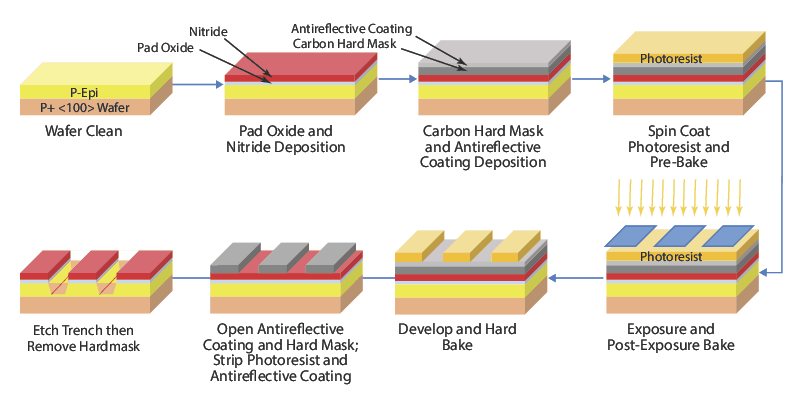
Etching is a vital process in semiconductor manufacturing that selectively removes material from the surface of a wafer to define the patterns necessary for circuit formation. This process is primarily categorized into two techniques: wet etching and dry etching, each with its own mechanisms and applications.
Wet etching uses chemical solutions to dissolve unwanted material, while dry etching utilizes plasma or reactive gases to remove material with greater precision. Understanding the differences between these methods is essential for optimizing process control, ensuring material compatibility, and achieving fine feature resolution in advanced semiconductor fabrication.
1.Differences in Etching Principles and Mechanisms
Wet Etching:
Wet etching employs liquid chemical etchants that come into direct contact with the material's surface and react chemically with it. Common solutions, such as acidic or alkaline mixtures, are used to dissolve the material's surface. The core function of wet etching is the chemical dissolution of materials, making it a purely chemical process. It can be likened to soaking clothes in detergent to remove impurities, where chemical reactions dissolve or eliminate unwanted substances.
Wet etching employs liquid chemical etchants that come into direct contact with the material's surface and react chemically with it. Common solutions, such as acidic or alkaline mixtures, are used to dissolve the material's surface. The core function of wet etching is the chemical dissolution of materials, making it a purely chemical process. It can be likened to soaking clothes in detergent to remove impurities, where chemical reactions dissolve or eliminate unwanted substances.
Plasma Etching:
Plasma etching, on the other hand, is a dry etching method that removes materials through reactions involving gaseous chemicals and plasma. Plasma is generated under high voltage, creating numerous free radicals and ions. These free radicals react chemically with the surface material, leading to the formation of volatile byproducts. Additionally, ion bombardment physically removes material. Thus, plasma etching combines both chemical and physical effects. It can be compared to using a special gas to "activate" the surface and "blow away" unwanted materials, effectively merging chemical reactions with physical processes.
Plasma etching, on the other hand, is a dry etching method that removes materials through reactions involving gaseous chemicals and plasma. Plasma is generated under high voltage, creating numerous free radicals and ions. These free radicals react chemically with the surface material, leading to the formation of volatile byproducts. Additionally, ion bombardment physically removes material. Thus, plasma etching combines both chemical and physical effects. It can be compared to using a special gas to "activate" the surface and "blow away" unwanted materials, effectively merging chemical reactions with physical processes.
2.Directionality of Etching (Isotropic and Anisotropic)
Wet Etching:
Wet etching is typically isotropic, meaning that the etching occurs uniformly in all directions. This results in a consistent etching depth, which can often lead to the creation of "burrs" or irregular profiles due to similar etching speeds in vertical and lateral directions.
Wet etching is typically isotropic, meaning that the etching occurs uniformly in all directions. This results in a consistent etching depth, which can often lead to the creation of "burrs" or irregular profiles due to similar etching speeds in vertical and lateral directions.
Plasma Etching:
In contrast, plasma etching is characterized by its anisotropic nature, with the etching predominantly occurring in the vertical direction and relatively less in the lateral direction. This is due to the primarily vertical ion bombardment in the plasma, allowing for more precise etching patterns. Plasma etching is especially suitable for creating high-accuracy patterns, particularly those smaller than 3 microns.
In contrast, plasma etching is characterized by its anisotropic nature, with the etching predominantly occurring in the vertical direction and relatively less in the lateral direction. This is due to the primarily vertical ion bombardment in the plasma, allowing for more precise etching patterns. Plasma etching is especially suitable for creating high-accuracy patterns, particularly those smaller than 3 microns.

3. Etching Selectivity
Wet Etching:
Wet etching boasts high selectivity and can effectively etch different materials by choosing appropriate chemical solutions. It can accurately remove specific materials without affecting others. Therefore, wet etching is typically employed in processes that do not require fine detail, such as photoresist removal, cleaning, and the elimination of certain dielectric materials.
Wet etching boasts high selectivity and can effectively etch different materials by choosing appropriate chemical solutions. It can accurately remove specific materials without affecting others. Therefore, wet etching is typically employed in processes that do not require fine detail, such as photoresist removal, cleaning, and the elimination of certain dielectric materials.
Plasma Etching:
The selectivity of plasma etching is generally lower because it involves the simultaneous effects of ion bombardment and chemical reactions. This dual action makes it challenging to achieve complete selectivity for a particular material. However, plasma etching excels at creating precise etches and is ideal for applications that demand high precision and intricate detailing.
The selectivity of plasma etching is generally lower because it involves the simultaneous effects of ion bombardment and chemical reactions. This dual action makes it challenging to achieve complete selectivity for a particular material. However, plasma etching excels at creating precise etches and is ideal for applications that demand high precision and intricate detailing.
4. Etching Speed
Wet Etching: The rate of wet etching is generally high, particularly when the concentration of the chemical solution is elevated, leading to a fast material removal rate. However, this method is typically unsuitable for etching complex patterns due to its isotropic etching characteristics, which can lead to over-etching in narrow gaps.
Plasma Etching: The etching rate for plasma etching is usually lower than that of wet etching, but it offers higher precision, making it ideal for fine pattern etching. The plasma etching rate is influenced by various factors, such as plasma power, gas flow, and pressure; therefore, it can be adjusted to meet specific processing requirements.
5. Process Environment and Equipment
Wet Etching: Wet etching employs liquid chemicals and requires a specialized chemical etching tank for operation. Given the corrosive nature of these liquids, it is crucial to maintain strict control over the concentration, temperature, and overall operating environment of the chemicals.
Plasma Etching: Plasma etching typically requires a gas reaction chamber and operates under low pressure or high vacuum conditions. The equipment is relatively complex and is generally equipped with an RF power source and a gas flow control system. Due to the presence of high-energy ions and free radicals in the plasma, safety precautions are essential to protect both the equipment and the operators during operation.
6. Scope of Application
Wet Etching: Wet etching is well-suited for relatively simple graphic etching or situations where precision in material removal is not a major concern. It is commonly used for more rudimentary etching tasks, such as removing photoresist and metallization layers.
Plasma Etching: Plasma etching is particularly effective for precision etching of small graphics, especially in integrated circuit manufacturing. When the graphic size is less than 3 microns, plasma etching becomes the preferred technology. It provides high-precision, anisotropic etching, making it suitable for complex pattern transfer and the production of microelectronic components.
Summary
Wet Etching: This method removes materials through liquid chemical reactions, making it suitable for rough removal applications. It offers high selectivity; however, the isotropic nature of the etching makes fine pattern etching challenging.
Plasma Etching: As a dry etching method that combines chemical reactions with physical ion bombardment, plasma etching provides high-precision anisotropic etching. It is especially suited for manufacturing small-sized integrated circuits.
In terms of pattern accuracy, material selectivity, and etching rates, plasma etching has irreplaceable advantages in modern microelectronics manufacturing, particularly for patterns smaller than 3 microns.
Semicorex offers high-quality CVD SiC rings for etching, meet the highest performance standards with precision and reliability. If you have any inquiries or need additional details, please don't hesitate to get in touch with us.
Contact phone # +86-13567891907
Email: sales@semicorex.com
Email: sales@semicorex.com
Atomic layer deposition (ALD)
Crystal Growth in Chip Manufacturing - Crystalline Control