Dislocations in 4H-SiC Single Crystals
2024-12-31
4H-SiC single crystals, with their wide bandgap, high carrier mobility, excellent thermal conductivity, and outstanding chemical stability, hold significant promise for applications in high-power electronics, RF/microwave electronics, and quantum information. However, the high dislocation density in 4H-SiC single crystals, reaching 10³ to 10⁴ cm⁻², severely limits their performance and hinders the full realization of their potential. Therefore, understanding the mechanisms of dislocation generation, transformation, and annihilation, as well as their impact on material properties, has become a critical research focus. This knowledge is essential not only for improving the quality of 4H-SiC single crystals but also for expanding their applications across various fields.
What Makes Dislocations in 4H-SiC Single Crystals Complex?
What Are the Types of Dislocations?
4H-SiC single crystals exhibit a variety of dislocation types, primarily categorized into threading dislocations (TDs) and basal plane dislocations (BPDs). Threading dislocations include micropipes (MPs), threading screw dislocations (TSDs), threading mixed dislocations (TMDs), and threading edge dislocations (TEDs), each with a unique Burgers vector, akin to a “signature” in the microscopic world. Basal plane dislocations are further divided into integrated BPDs and decomposed BPDs, also possessing specific Burgers vectors. These diverse dislocation types interweave within the 4H-SiC single crystal, creating a complex and intricate microstructure.

How Does Dislocation Density Vary?
In 4H-SiC single crystal substrates, the density of various dislocations differs significantly. Micropipes (MPs) have a relatively low density, below 0.1 cm⁻², while threading screw dislocations (TSDs) and threading mixed dislocations (TMDs) range from 300 to 500 cm⁻². Threading edge dislocations (TEDs) have a higher density, reaching 2000 to 5000 cm⁻², and basal plane dislocations (BPDs) fall between 500 and 1000 cm⁻². This uneven distribution of dislocation densities adds complexity to the study and control of dislocations.
How Do Dislocations Evolve During 4H-SiC Single Crystal Growth?
What Causes Dislocation Generation?
The generation of dislocations during the growth of 4H-SiC single crystals is closely related to several factors. Thermal stress induced by temperature gradients, stress from second phases, two-dimensional nucleation islands, voids, or inclusions all serve as “breeding grounds” for dislocations. Threading dislocations (TDs) in seed crystals tend to propagate along the growth direction due to their “hereditary” nature, while basal plane dislocations (BPDs) primarily arise from thermal stress.

How Do Dislocations Transform and Annihilate?
During growth, dislocations not only generate but also transform. For instance, micropipes (MPs) and threading screw dislocations (TSDs) can convert into each other, and TSDs can transform into Frank-type dislocations (SFs). Threading edge dislocations (TEDs) and basal plane dislocations (BPDs) also undergo mutual conversion. Additionally, TSDs may interact during crystal growth, leading to dislocation annihilation. These complex transformation processes resemble a “metamorphosis” and “disappearance act” in the microscopic world, showcasing the dynamic evolution of dislocations in 4H-SiC single crystals.
How Do Dislocations and Deformation Interact During 4H-SiC Wafer Processing?
When 4H-SiC crystal ingots undergo processing steps such as wire cutting, grinding, and chemical mechanical polishing, a fierce interplay between dislocations and deformation occurs. The deformation process of 4H-SiC can be divided into five stages: elastic deformation, plastic deformation, microcrack formation, crack propagation, and brittle removal. The presence of dopant impurities also significantly influences this process. With impurity concentrations exceeding 10¹⁸ cm⁻³, the nucleation kinetics of basal plane dislocations (BPDs) are affected, impacting the deformation mechanism and mechanical properties of 4H-SiC. This makes the control of dislocations during processing more complex and challenging.
How Do Dislocations Persist and Affect During 4H-SiC Homoepitaxy?
During the homoepitaxial growth of 4H-SiC, dislocations in the substrate continue to exert their influence. Over 95% of threading screw dislocations (TSDs) extend into the epitaxial layer, while most basal plane dislocations (BPDs) initially convert to threading edge dislocations (TEDs), though some BPDs persist in the epitaxial layer. These dislocations act like “hidden demons” within devices, adversely affecting performance by causing electron-hole recombination and reducing device reliability, thus hindering the application of 4H-SiC in high-performance devices.
What Is the Profound Impact of Dislocations on 4H-SiC Properties?
How Are Dislocations Revealed Under Molten Alkali Corrosion?
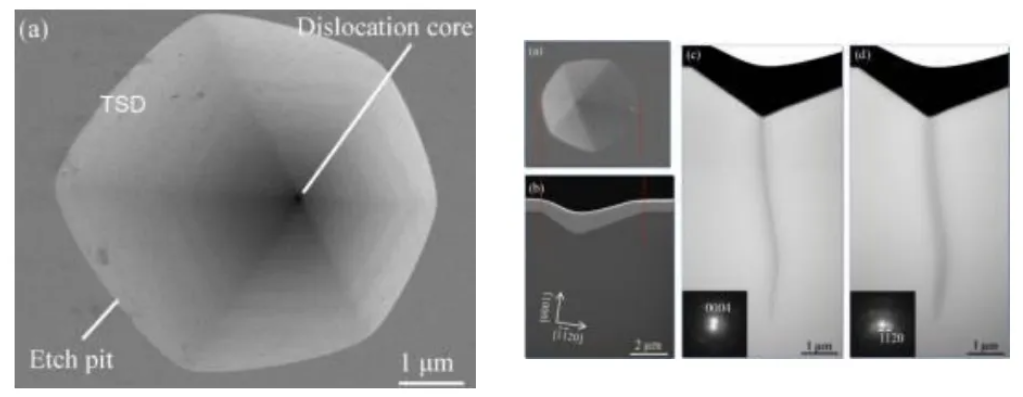
Molten alkali corrosion is a straightforward method for revealing dislocations in 4H-SiC and assessing their density. By observing the shape and size of corrosion pits, insights into lattice distortion caused by dislocations can be gained, akin to tracing the “footprints” left by dislocations within the crystal. This provides important clues and evidence for further dislocation research.
How Do Dislocations Interfere with Electrical Performance?
In the electrical domain, dislocations act as “troublemakers,” significantly impacting the performance of 4H-SiC devices. Threading screw dislocations (TSDs) function as “leakage channels,” enhancing leakage effects, while basal plane dislocations (BPDs) serve as “electron traps,” becoming centers for electron-hole recombination, negatively affecting both forward and reverse device performance, making it challenging for 4H-SiC devices to achieve ideal electrical performance metrics.
How Do Dislocations Illuminate Optical Properties?
Despite the challenges posed by dislocations, they also exhibit unique advantages in the optical domain. Dislocations, as radiative recombination centers, can produce photoluminescence, akin to faint starlight in the dark. Additionally, by adjusting the emission wavelength, it is possible to display individual partial dislocations and stacking faults, offering new perspectives and methods for optical detection and research in 4H-SiC.
Conclusion
The study of dislocations in 4H-SiC single crystals, while challenging, holds immense potential. With the relentless efforts of researchers, it is hoped that the mysteries of dislocations will be unraveled, effective control methods will be discovered, and 4H-SiC single crystals will fully realize their exceptional performance, driving revolutionary breakthroughs in high-tech fields and ushering in a new era of semiconductor material applications.
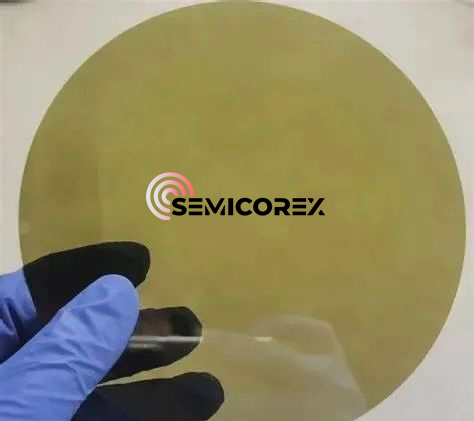
We at Semicorex supplies 4H-SiC Wafers with competitive pricing and exceptional performance, if you have any inquiries or need additional details, please don't hesitate to get in touch with us.
Contact phone: +86-13567891907
Email: sales@semicorex.com
Ion Implantation: Halo Implant
Selective Deposition Technology
Related Article
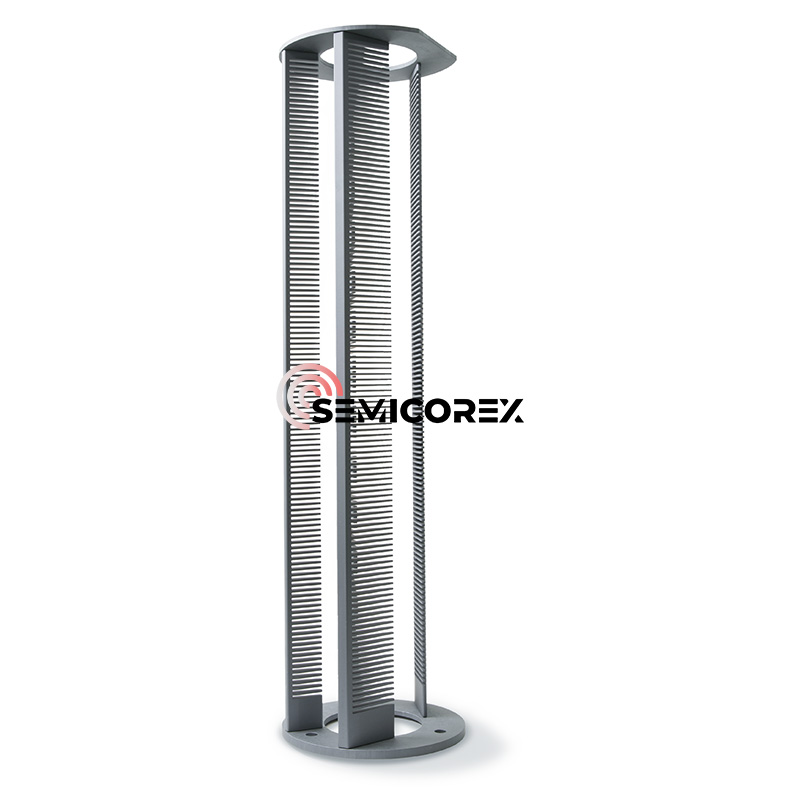
Chip processing requires numerous steps, including wafer cleaning, thermal oxidation, thin film deposition, photolithography, etching, ion implantation, annealing, diffusion, chemical mechanical polishing, and testing, ultimately resulting in a specific integrated circuit structure on the wafer.
Silicon Components in Heat Treatment
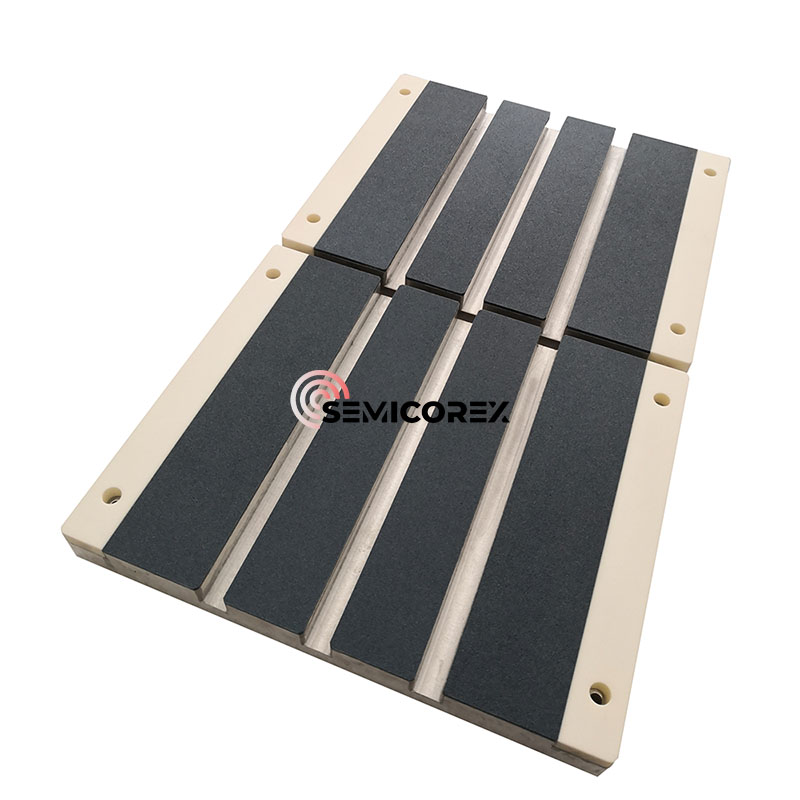
In recent years, with the continuous improvement of the performance and output of chip/thin-film electronic components such as solar cells, light-emitting diodes, semiconductors, and liquid crystal displays, there is an increasing demand for vacuum suction cups for component clamping that provide higher precision and performance.
Porous ceramic vacuum chucks