What is PBN crucibles?
2025-04-25
Crucible is a cup-shaped vessel used in the chemical industry. It was first used in alchemical experiments to hold liquids or solids for high-temperature heating. It is the basis for ensuring the smooth progress of chemical reactions. The material of the crucible is required to be heat-resistant and strong, and it is not easy to react chemically at high temperatures. The earliest crucibles in history were made of clay. In modern times, they can be made of any material that can melt or change its contents, such as quartz ceramics, corundum, boron nitride, zirconium oxide, graphite, and metals such as platinum, nickel, and chromium.
Among them, boron nitride (BoronNitride) is an advanced ceramic material with broad application prospects. It is a crystal composed of nitrogen atoms and boron atoms. The chemical composition is 43.6% boron and 56.4% nitrogen. It has four different variants: hexagonal boron nitride (HBN), cubic boron nitride (CBN), rhombohedral boron nitride (RBN), and wurtzite boron nitride (WBN).
Since the boron nitride material has a thermal expansion coefficient comparable to that of quartz, but its thermal conductivity is 10 times that of the latter, it has excellent thermal shock resistance, which can reduce the risk of cracking due to rapid temperature changes, and can be cycled several times at 20~1200℃ without any problems. In addition, boron nitride does not react with acids, alkalis, glass, and most metals, and has low mechanical strength, only slightly higher than graphite, but does not soften under load at high temperatures, and can be processed by general metal processing machines, so it is indeed suitable for use as crucibles, vessels, liquid metal delivery pipes, and molds for steel casting for melting and evaporating metals.
PBN crucibles are usually made by chemical vapor deposition using boron-containing gas (BCl3 or B2H6) as raw material. However, because B2H6 is highly toxic, BCl3 is currently used as raw material. The boron-containing gas undergoes pyrolysis (1500~1800℃) and reacts with NH3 in a high-temperature reaction chamber to form solid boron nitride. The chemical equation is as follows. Because pyrolysis occurs in the reaction, it is also called pyrolysis boron nitride crucible (commonly known as PBN crucible).
BCl3+NH3=BN+HCl

pic - PBN crucible with PG coating
The growth process of PBN material is similar to "falling snow", that is, the hexagonal BN snowflakes grown in the reaction are continuously piled on the heated graphite substrate (core mold). As time goes on, the accumulation layer thickens, forming the PBN shell. The demolding is an independent, pure PBN component, and the PBN coating is left on it. Since the PBN crucible does not need to go through the traditional hot pressing sintering process and does not need to add any sintering agent, it has a very high purity (more than 99.99%). The operating temperature under vacuum is as high as 1800 degrees, and the operating temperature under atmosphere protection can reach up to 2100°C (usually nitrogen or argon). It is mostly used in evaporation/molecular beam epitaxy (MBE)/GaAs crystal growth and other purposes.
Porous ceramic vacuum chucks
Multi-applications of silicon carbide ceramics
Related Article
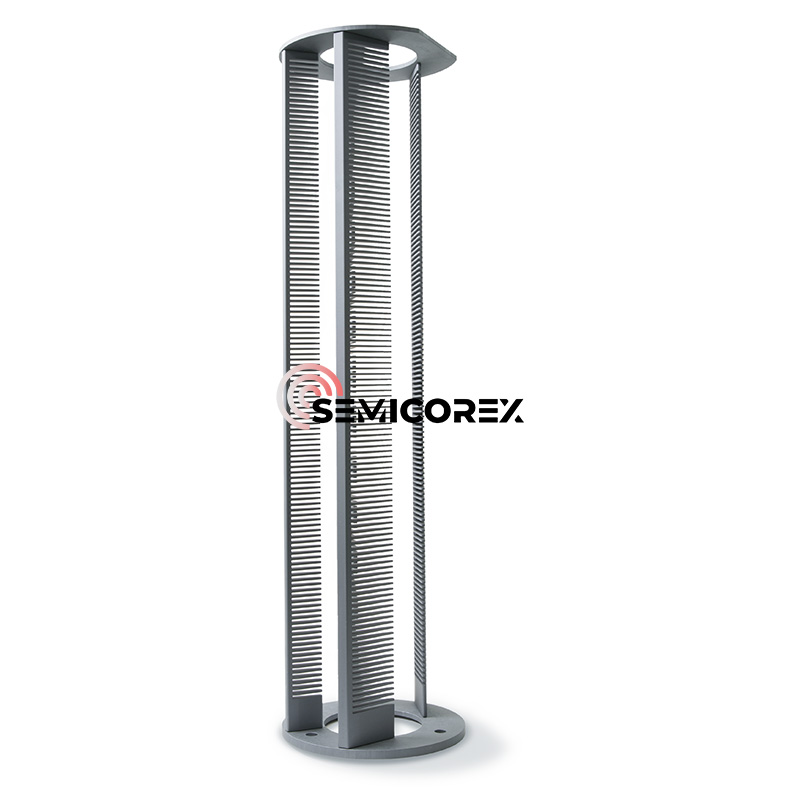
Chip processing requires numerous steps, including wafer cleaning, thermal oxidation, thin film deposition, photolithography, etching, ion implantation, annealing, diffusion, chemical mechanical polishing, and testing, ultimately resulting in a specific integrated circuit structure on the wafer.
Silicon Components in Heat Treatment
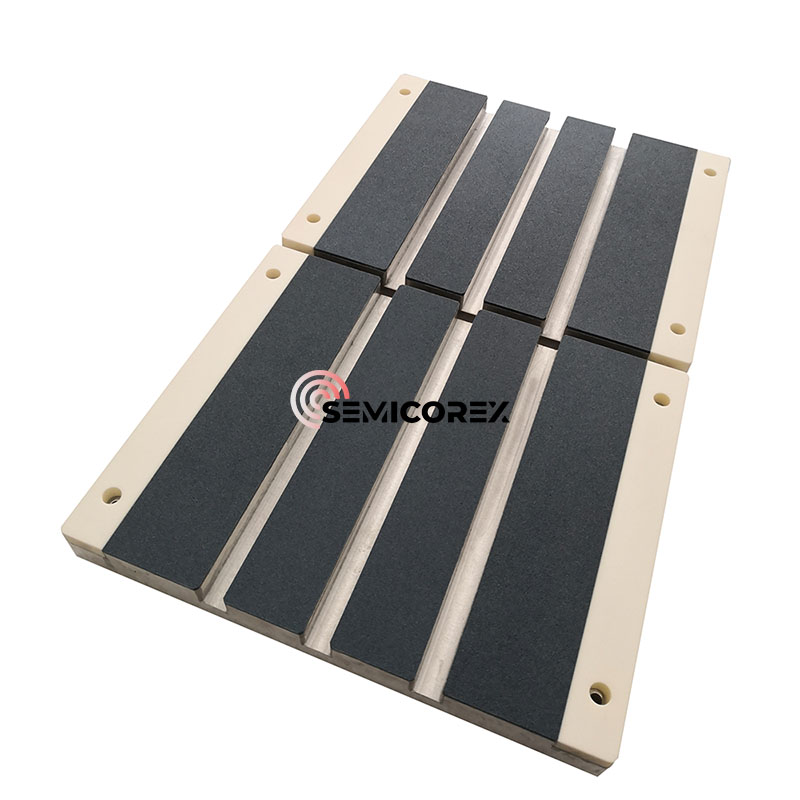
In recent years, with the continuous improvement of the performance and output of chip/thin-film electronic components such as solar cells, light-emitting diodes, semiconductors, and liquid crystal displays, there is an increasing demand for vacuum suction cups for component clamping that provide higher precision and performance.
Porous ceramic vacuum chucks