


TaC Coating Guide Ring
Quantity:
TaC Coating Guide Ring
Semicorex TaC Coating Guide Ring is for single crystal growth, enhancing process efficiency and crystal quality and simplifying maintenance.
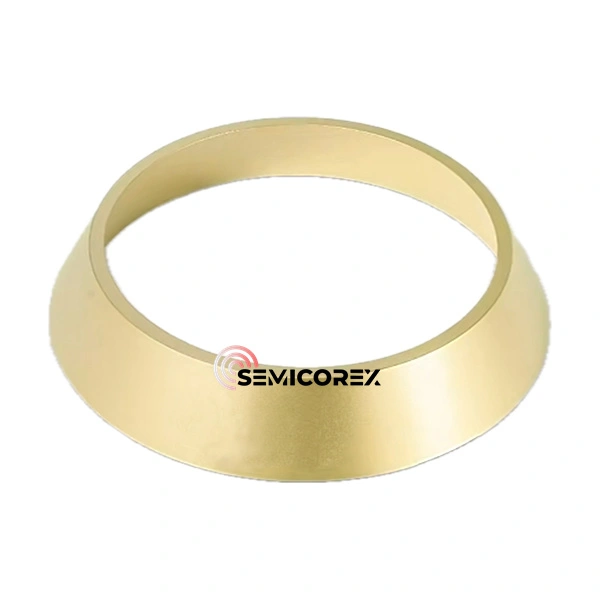
Thermal Resistance of the TaC Coating Guide Ring
The TaC Coating Guide Ring is distinguished by its extraordinary thermal properties, primarily attributed to the tantalum carbide (TaC) coating. One of the most striking features of this material is its formidable melting point, which soars to an impressive 3880°C. This exceptional thermal resistance allows the guide ring to function effectively in environments characterized by temperatures exceeding 2000°C, provided that these conditions are devoid of oxygen. Such robust thermal performance positions the TaC Coating Guide Ring as an essential component in crystal growth where extreme heat resistance is paramount.
Stability Under High Temperatures of the TaC Coating Guide Ring
In addition to its high melting point, the TaC coating offers superior stability at elevated temperatures during crystal growth. This characteristic makes it an ideal choice for use as an ablative coating, where it significantly outperforms silicon carbide (SiC). As an oxidation-resistant coating, it protects the underlying materials from degradation, ensuring long-term reliability. Such stability of the guide ring ensures that components with TaC coating maintain their performance and functionality, even under prolonged exposure to intense heat in crystal growth furnaces.
Chemical Corrosion Resistance of the TaC Coating Guide Ring
Beyond its thermal capabilities, the TaC Coating Guide Ring exhibits outstanding resistance to chemical corrosion in crystal growth processes. It maintains its structural integrity when exposed to a variety of corrosive agents, including ammonia (NH3), hydrogen (H2), silicon (Si), and hydrogen chloride (HCl) vapors. This resistance is particularly important in the high-temperature application of crystal growth where such chemicals are frequently present and can pose significant risks to component longevity and effectiveness. The ability of the guide ring to withstand these aggressive environments without succumbing to corrosion ensures that the TaC Coating Guide Ring remains a reliable and durable choice for single crytsal growth.
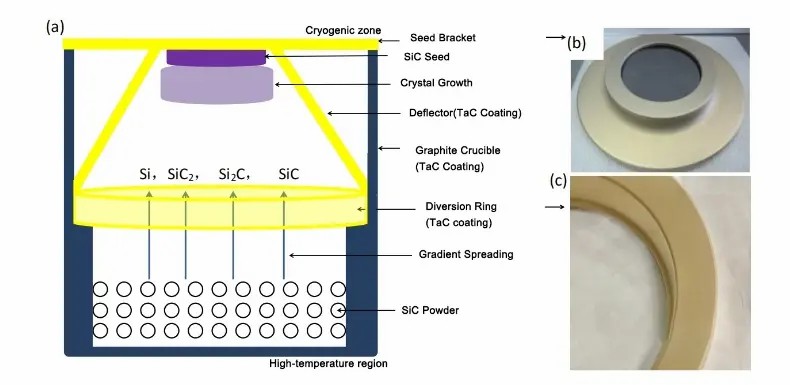
TaC Coating Guide Ring in the SiC Crystal Growth
Enhancement of Crystal Growth Process Yield and Crystal Quality
The integration of the TaC Coating Guide Ring within single crystal growth furnaces has a profound impact on both process yield and the quality of the produced crystals. In the realm of silicon carbide (SiC) and aluminum nitride (AlN) crystal growth, the TaC coating facilitates a controlled and consistent crystal growth process. This consistency of the guide ring is essential for achieving high-purity crystals, which are a critical requirement in crystal growth processing. By optimizing the growth environment, the TaC Coating Guide Ring ensures that the crystals formed are of superior quality, thereby enhancing the overall efficiency and output of the single crystal growth process.
TaC Coating Role in SiC Epitaxial Equipment
Within SiC epitaxial growth equipment, the TaC Coating serves a pivotal role. A noteworthy benefit of utilizing TaC as a coating is the observed reduction in SiC growth rate on the TaC surface compared to SiC-on-SiC growth. This slower crystal growth rate is advantageous as it mitigates issues related to the shedding of particulates and shortens maintenance cycles, enhancing both the performance and the longevity of the equipment. By addressing these common challenges, the TaC Coating contributes to a more stable and efficient operation, reducing the need for frequent interventions and maintenance.
Simplified Maintenance and Cleaning
Another significant advantage of the TaC Coating is its contribution to simpler maintenance procedures. The excess deposition of SiC and other materials on the TaC coating does not result in strong chemical metallurgical bonding. This characteristic simplifies the cleaning process, as these deposits can be removed more easily compared to those that form on SiC coatings. The ease of maintenance not only reduces downtime but also extends the operational lifespan of the equipment, making it a cost-effective solution for industries requiring high-performance components.
Recommend Products


